- The problem
- Chatbots answer with confidence even when the documents do not cover the question.
- What I built
- Every answer must cite numbered sources. When nothing relevant is found, it says it does not know and shows the nearest pages it searched.
- Result
- Refused 100% of the 8 off topic questions and 83% of the 6 in domain questions whose answer is not in the indexed pages.
- 96% of answers carried a citation, and 0.97 of the citations supported the sentence they sat on (judge scored).
Case study, retrieval augmented generation
ragx: a docs assistant that cites its sources and says when it does not know
Ask a question about the FastAPI or Pydantic documentation. Every answer links to the pages it came from, off topic questions are refused, and every claim on this page is a measured number with its limits next to it.
The demo runs on a free server that sleeps when idle, so the first load can take about a minute. Choose Continue as guest to try it without an account.
97%
of 38 held out questions had a correct documentation page in the top five results
0.93
answer faithfulness on 43 questions, scored by a judge model from a different family
0 of 7
personal data cases leaked in an end to end test (a control that turns the guards off leaks all of them)
$0
paid model spend in the end to end eval run. Everything ran on free tiers
Four problems, and what happened when I measured the fix
Each card names the problem, what I built, and the number I got. The limits are in the section further down.
- The problem
- Keyword search and embedding search each miss pages the other one finds.
- What I built
- Hybrid retrieval: BM25 keyword search and dense embeddings, merged by reciprocal rank fusion. Hits expand to the whole documentation section, so the model sees full context.
- Result
- On held out questions, nDCG@10 is 0.84 for hybrid against 0.81 for keyword and 0.80 for embeddings.
- hit@5 is 97% against 89% for either method alone.
- The problem
- Free model tiers rate limit, change and fail, so one provider is a single point of failure.
- What I built
- A router tries Groq, Cerebras and Gemini in order, with fallback, a circuit breaker and quotas. A paid key exists only as a capped last resort and is off by default. An exact plus semantic cache answers repeats without a model call.
- Result
- Paid spend in the end to end eval run: $0. The semantic cache served 61% of paraphrased questions with 0% wrong hits at the chosen threshold.
- The honest cost: on free tiers the median answer took 2.6 s but the slowest 5% took 63.8 s when providers rate limited, and 73% of calls used a fallback in that run.
- The problem
- Assistants follow instructions hidden in questions and documents, and leak personal data.
- What I built
- Input checks block injection and redact emails, keys and phone numbers before any model sees them. Retrieved chunks that carry instructions are dropped, and outputs are checked. Memory needs consent and rejects secrets.
- Result
- Blocked 92% of 24 attack prompts, with 0% false refusals on 17 benign look alikes.
- 0 of 7 personal data cases leaked into a model input, response, log, memory or cache.
See it working
Screenshots from a local run of the same build that is deployed. The questions are real; the answers come from free tier models.
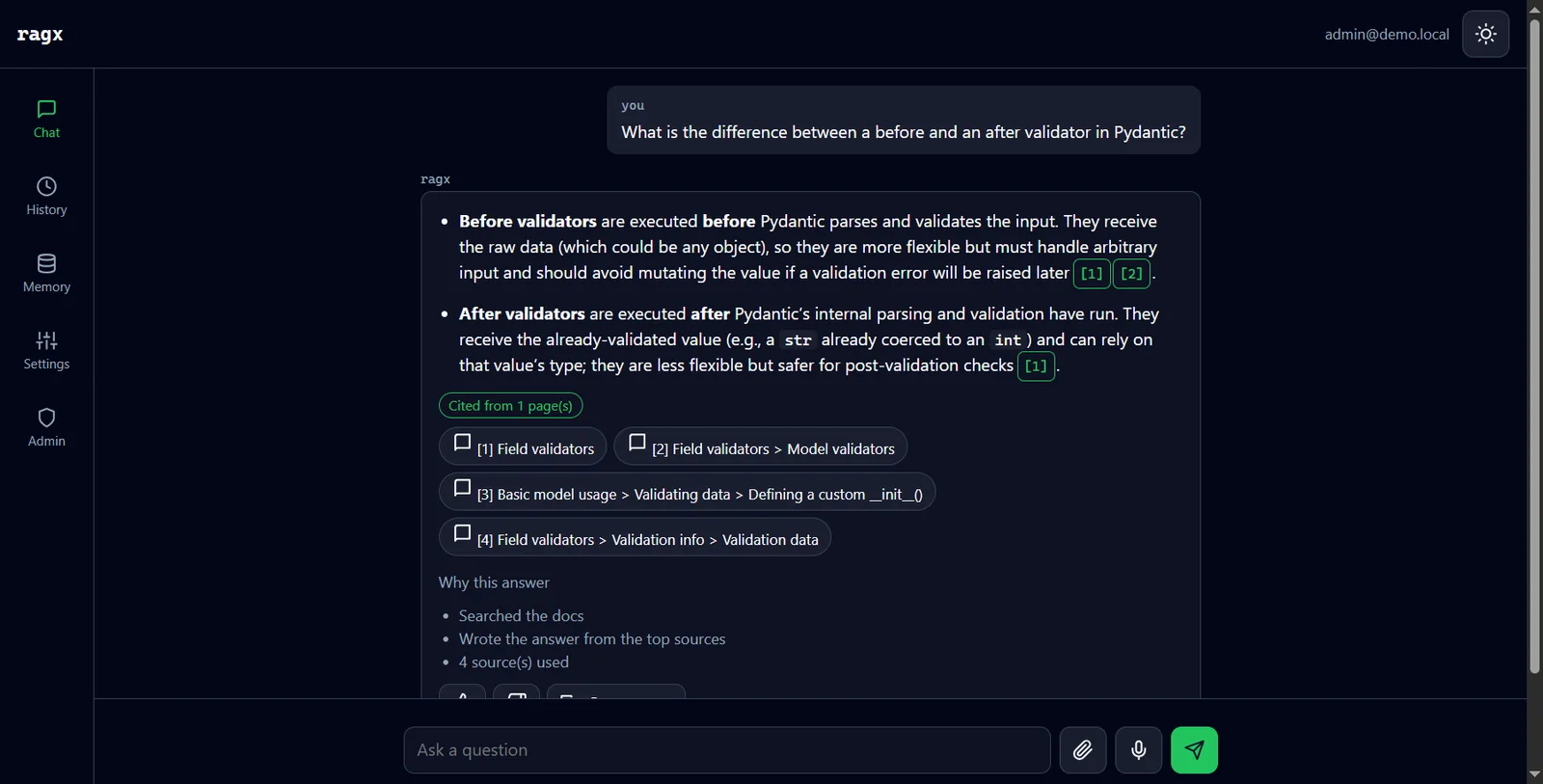
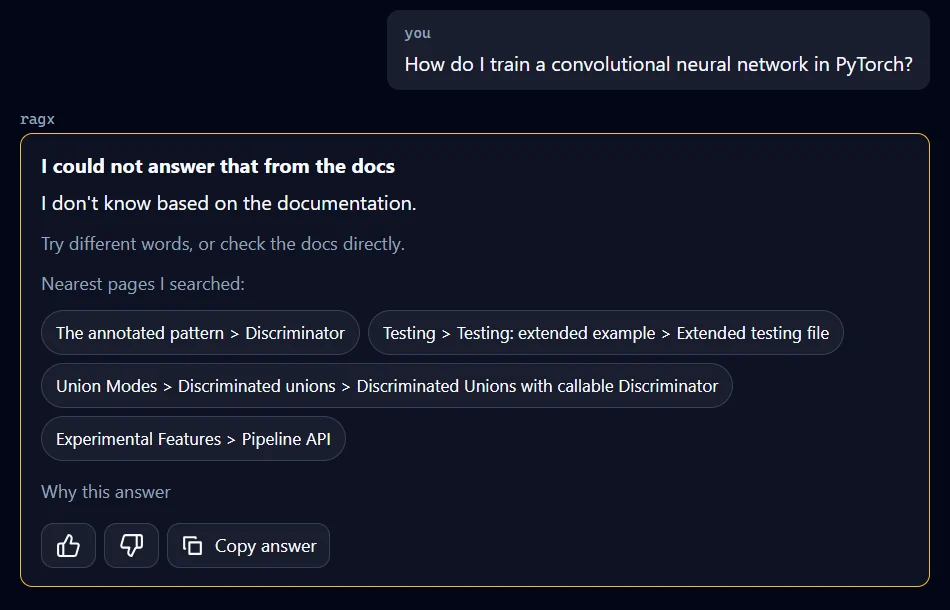
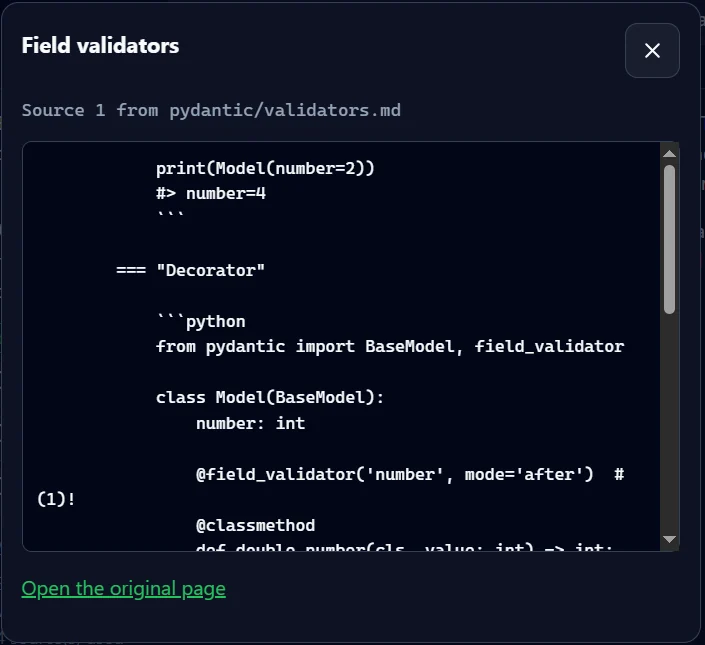
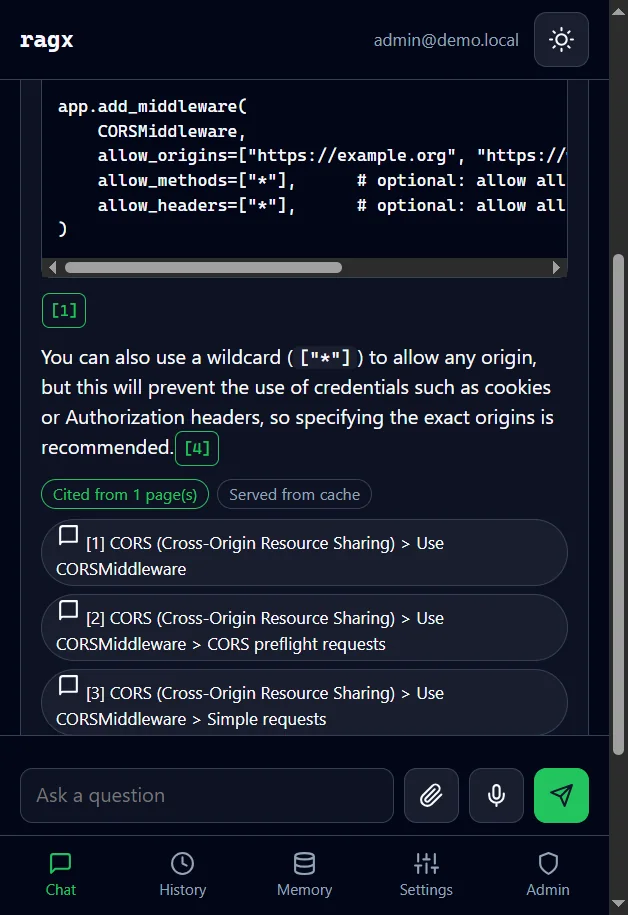
How a question is answered
Six steps. Each one exists because a measurement or a failure showed it was needed.
Step 1
Check the question
Length limit, prompt injection check, and redaction of emails, keys and phone numbers.
Step 2
Look in the cache
An exact match or a very similar earlier question returns at once, with no model call.
Step 3
Search the docs
BM25 and embeddings run side by side and are merged by rank. Results expand to whole sections.
Step 4
Ask a model
A router picks a free provider and falls back if it is rate limited or down.
Step 5
Check the answer
Citations must point at real sources, and personal data is removed from the reply.
Step 6
Measure everything
Each query is traced, counted in Prometheus, and a sample is scored by a judge model.
Evals: what I measured
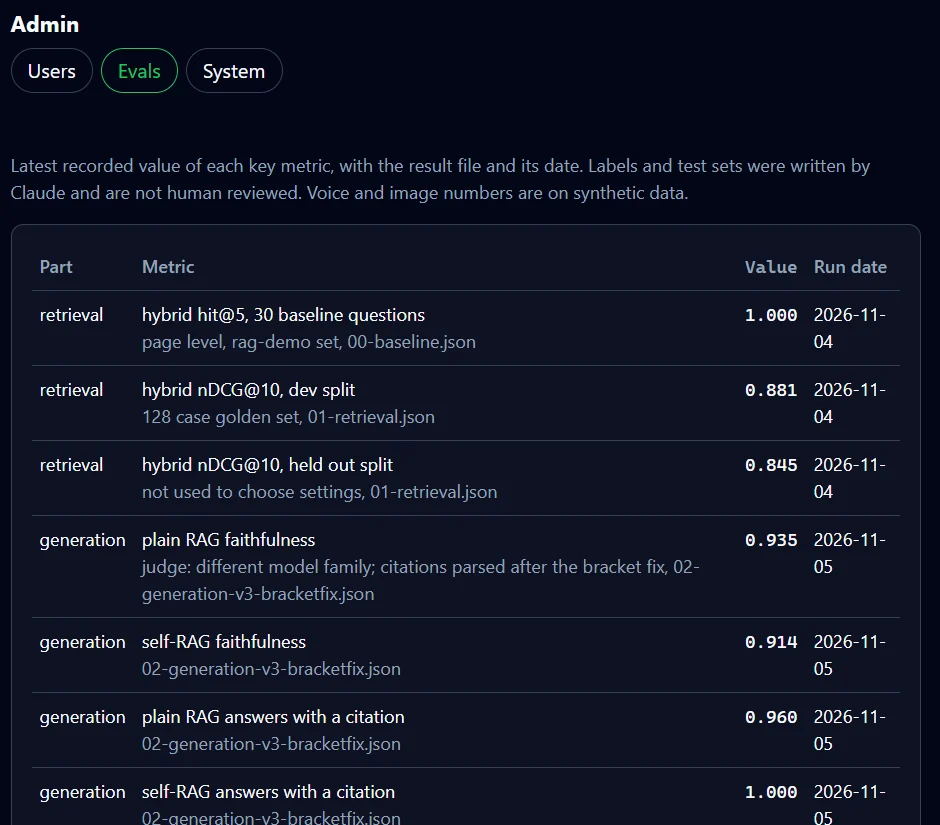
One change at a time, on a fixed set of 128 golden questions (90 to tune on, 38 held out and never used to choose settings). Results that got worse are kept and shown. Every chart names its source file in the repository.
Retrieval: hybrid search wins, and the reranker made it worse
nDCG@10 per retrieval mode. Higher is better. Hybrid also scored hit@5 of 97% on the held out questions. A cross encoder reranker scored lower and took about 1.9 s per search instead of 16 ms, so I left it out.
- Dev split (90 questions)
- Held out (38 questions)
Keyword (BM25)
median search 14 ms
0.820.81Dense embeddings
median search 10 ms
0.830.80Hybrid (shipped)
median search 16 ms
0.880.84Hybrid plus reranker
median search 1.9 s
0.800.79Hybrid plus MMR
median search 12 ms
0.840.82
Source: eval/results/01-retrieval.json
Self RAG against plain RAG: more calls, no better answers
Self RAG adds retrieval grading and answer checking. On 43 questions it used 3.9 model calls and 2,548 tokens per question against 1 call and 1,188 tokens, and was not more faithful, so plain RAG is the default. Differences of a few points on this many questions are within noise.
- Plain RAG (shipped)
- Self RAG
Faithfulness
claims supported by the sources
0.930.91Citation accuracy
citations that support their sentence
0.970.96Answers with a citation
0.961.00Refusal correct
answers when it should, refuses when it should
0.880.93
Source: eval/results/02-generation-v3-bracketfix.json
Safety rules, before and after one round of fixes
The second round changed rules after seeing which cases failed, and the same cases are the test set, so the after numbers are partly tuned on their own test data. Two social engineering attacks are still missed.
- Round 1
- Round 2
Attack prompts blocked
24 attacks, higher is better
83.3%91.7%Benign questions wrongly refused
17 look alikes, lower is better
11.8%0.0%Personal data found exactly
12 cases, higher is better
83.3%100.0%
Source: eval/results/04-safety-v1.json and eval/results/04-safety.json
Conversation memory helps follow up questions
Rewriting a follow up like “and how do I validate it?” using the earlier turns. Retrieval only, 12 cases written by Claude, so treat it as an indication.
- Without memory
- With memory
hit@5
0.580.83Mean reciprocal rank
0.370.71
Source: eval/results/04-memory.json
Voice and image input
Tested on 18 synthetic voice clips and 18 rendered images, so these numbers are optimistic. A glossary prompt lowered the word error rate. No hidden instruction in an image reached the pipeline.
Word error rate, plain
lower is better
6.1%Word error rate, with glossary
lower is better
4.6%Key terms read from images
0.91Right page in the top five from an image
0.94
Source: eval/results/05-voice-glossary.json, eval/results/05-voice-plain.json and eval/results/05-image.json
Approximate search indexes at 100,000 vectors
A study of scale, not of this app: the real corpus has only 907 chunks, where exact search is already fast. At 100,000 synthetic vectors, HNSW and IVF settings that reach full recall run roughly 15 to 60 times faster than exact search (up and to the left is better).
- Exact
- HNSW
- IVF
Source: eval/results/01-ann.json
Context precision, judged by a model
0.81
Rank weighted share of the sources sent to the answer model that are useful for the question, over all 128 golden questions. Dev 0.81, held out 0.81. 50% of sources were judged useful and 95% of questions had at least one.
The judge agrees with the page label only 74% of the time, and I have not calibrated it by hand for this task, so read this as a rough signal. Context recall is not measured because the golden set has no reference answers.
Source: eval/results/01-context-precision.json
Personal data leak test
0 of 7
Cases with an email, key, token or phone number went through the real app with a stub model built to behave as badly as possible: it echoes everything it receives and tries to save the user's words as a memory. I then searched the model input, the response, the trace log, the audit log, memories, history and the cache. Nothing leaked, and none leaked from text read out of a screenshot.
A control run with the guards switched off leaked 7 of 7 cases through the same harness, so the zero is not a blind spot. Limits: seven cases, only patterns the rules can detect (names and addresses are not detected), and a stub, not a real model.
Source: eval/results/04-pii-leak.json
Watching it run
Prometheus scrapes the service and Grafana draws the online evals, so quality is watched after release as well as before.
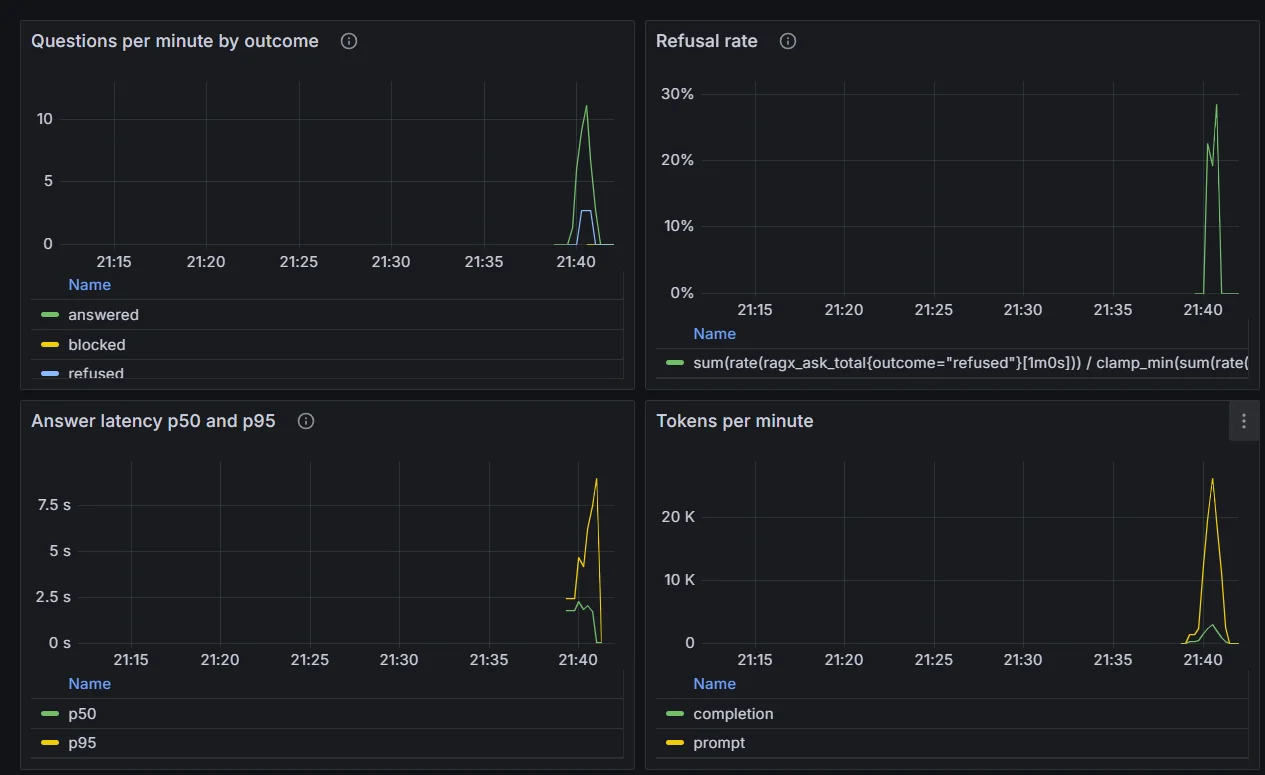

These panels come from a local run with a short burst of test questions, not production traffic. In the deployed service the sample rate defaults to 5% of answers. The alert thresholds are placeholders until a few weeks of real traffic can tune them.
What did not work, and what is not proven
The failures are part of the result. A portfolio that only shows wins is hard to trust.
The reranker lowered quality and added seconds
It scored below plain hybrid search on nDCG@10 and took 1.9 s a search, so it is not in the product.
Self RAG was not worth its cost
About 4 times the model calls for no gain in faithfulness on this set.
Free tiers are slow when they push back
Median 2.6 s, but 63.8 s at the 95th percentile when providers rate limited. A paid key would fix that and is deliberately off.
The labels are unreviewed
Beyond the 30 baseline questions, the golden questions and all safety labels were written by an AI assistant (Claude) and a human has not reviewed them. The judge model agreed with its calibration labels on 30 of 30 cases, but with unreviewed labels that is weak evidence.
Voice and image tests are synthetic
Generated voices and rendered images are cleaner than real ones. Real phone recordings and real screenshots would score lower.
Not measured yet
Context recall, a personal data leak rate on live answers with a real model, and two completed scheduled eval runs. Names and addresses are not detected as personal data.
Built like a service, not a notebook
- FastAPI backend with argon2 password hashing, short lived tokens with refresh rotation, role based access, rate limits and an audit log.
- A web app that installs like an app, with voice and screenshot input, history, memory with consent and an admin area.
- 139 automated tests. GitHub Actions run them on every push and run the evals on a schedule, and a regression gate compares each run with the last good one.
- A container image that runs as a non root user, deployed on a free Render service, with secrets only in the host settings.
- Docs pinned to exact upstream commits, so every eval can be repeated on the same text.